In a nutshell
- 🌱 Winter planting delivers vernalisation, strong root establishment, stable moisture, and lower pest pressure, easing the spring bottleneck and propelling growth when days lengthen.
- 🧄 Choose chill-friendly crops: garlic, shallots, broad beans (e.g., ‘Aquadulce Claudia’), sweet peas, and budget-friendly bare-root roses and fruit; avoid tender veg until spring warmth.
- 🧤 Prioritise soil and protection: add organic matter, use raised beds for drainage, mulch, and deploy fleece/cloches; time work by soil temperature and local frost patterns.
- 🧰 Garden smarter: keep a data-led journal, use a soil thermometer and cold frames, choose peat-free compost, sow green manure, harvest rainwater, and adopt no-dig methods.
- 🌼 The payoff is clear: earlier blooms and harvests, sturdier plants, and a calmer spring thanks to microclimate-aware, timely winter actions that turn cold into a collaborator.
Winter in Britain feels dormant, but the soil never truly sleeps. Get the timing and technique right now and spring will explode with colour and crops. Gardeners planning for 2026 have a quiet advantage: longer baseline datasets, better cold-tolerant varieties, and smarter protection. Planting in winter sets the spring tempo by exploiting cold, moisture, and lower pest pressure. Think structure, not speed. Think roots, not shoots. From bare-root trees to garlic and hardy annuals, cold-season planting builds resilience. It’s also thrifty. Fewer losses, fewer inputs, less fuss. Read the weather, read your soil, and sow confidence. Your March self will thank your January self.
Why Winter Planting Works
Winter confers three quiet gifts: vernalisation, moisture stability, and time. Many species need weeks of chill to trigger strong spring growth, a physiological reset that turbocharges blooming and fruiting. Cold is not always the enemy; for numerous crops it’s the key. Roots venture into cool soil while top growth rests, easing transplant shock. With sunlight low and pests scarce, plants spend energy underground, knitting a foundation that pays back when day length surges. In practical terms, this means autumn-into-winter plantings hit spring like a sprinter already moving.
There’s also a scheduling dividend. Winter planting spreads labour, reduces the frantic spring bottleneck, and frees bench space under lights. In heavy rainfall, beds hold moisture, but the cooler air curbs evaporation, so you water less and stress less. Yes, risks exist—waterlogging, extreme cold snaps, nibbling rodents—but with fleece, mulch, and vigilance they’re manageable. Plan for cold, not against it. Choose windows after hard frosts but before persistent freeze-thaw churns your soil into porridge. The rule of thumb: if the ground is workable and drains promptly, you can plant.
Choosing Crops and Bare-Root Stock
Not everything enjoys a winter start, so be selective. Garlic and shallots relish chill, producing larger bulbs and earlier harvests. Broad beans (especially ‘Aquadulce Claudia’) sown late autumn to mid-winter root deeply, flower early, and sidestep blackfly surges. Sweet peas sown in December create stout plants with stronger stems. Ornamental borders? Winter is the bargain window for bare-root roses, fruit trees, and hedging. These arrive dormant, cheaper, and infinitely easier to establish than pot-grown alternatives. Buy once, plant right, and let dormancy do the heavy lifting.
For bulbs, late-planted tulips still deliver, especially if soil drains sharply. Hardy annuals—cornflowers, larkspur, nigella—can be autumn-sown in milder areas or under cloches elsewhere, flowering weeks earlier than spring sowings. Avoid tender veg. Save tomatoes and cucurbits for spring warmth. If in doubt, lean on microclimates: a south-facing wall, a raised bed with grit, a cold frame that shaves wind and sheds rain. Matching crop to site is half the craft; the other half is timing to your postcode’s last frost profile.
| Crop/Plant | Winter Window (UK) | Spring Payoff |
|---|---|---|
| Garlic | Oct–Jan | Larger bulbs, earlier harvest |
| Broad beans | Nov–Feb | Early pods, fewer pests |
| Sweet peas | Nov–Jan | Stronger plants, longer bloom |
| Bare-root roses/fruit | Nov–Mar | Better establishment, lower cost |
| Tulips | Nov–Jan | Reliable flowering, bold colour |
Soil, Protection, and Timing
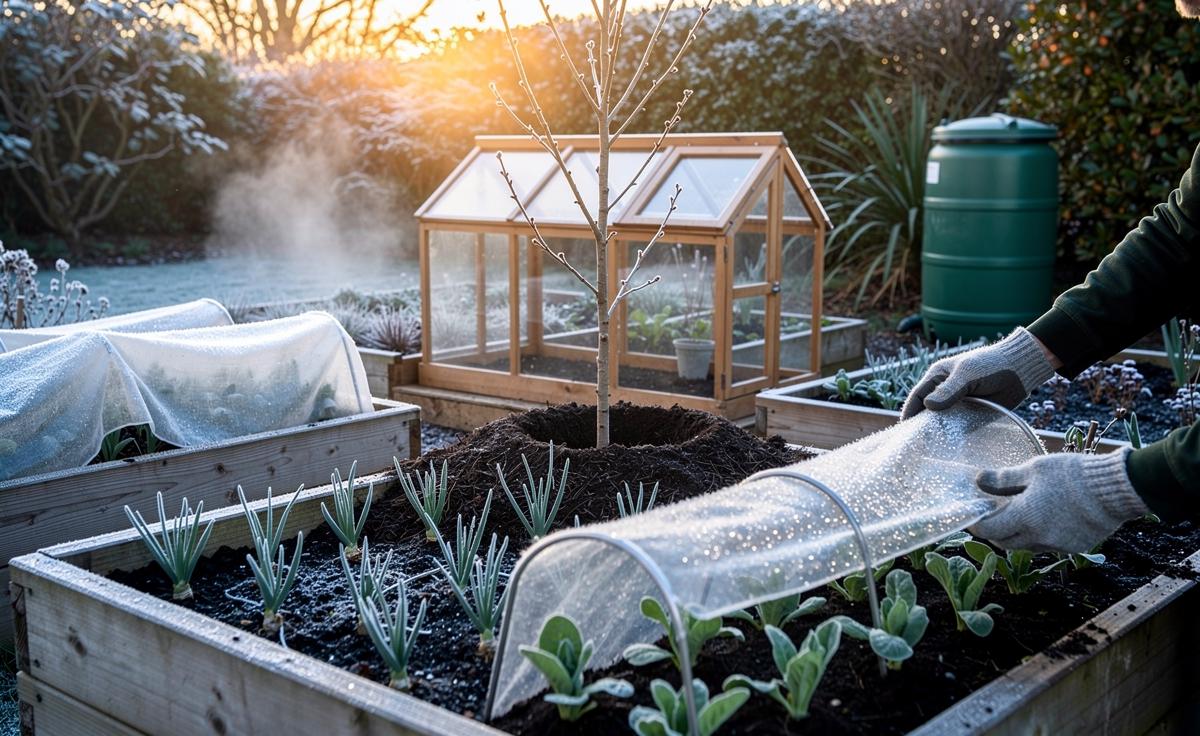
Winter success hinges on soil structure. Work only when it crumbles in the hand; wet clay smears, collapsing pores and suffocating roots. Add organic matter on top—let worms do the digging. In very wet spots, switch to raised beds or add grit for drainage. Mulch garlic and shallots with straw to soften temperature swings. Protect crowns from rot and roots from waterlogging; that’s half the battle. For young seedlings, think layers: cloches against rain, fleece against frost, mesh against pigeons, and windbreaks to halt desiccation. Protection is modular, and you can scale it up or down overnight.
Timing is local. Study your first and last frost dates, but don’t worship them—watch soil thermometers and 10-day forecasts. After a hard freeze, pockets of cold linger in dips and along walls. Use that knowledge. Morning planting on a rising temperature is kinder than late-day digs before a frost. Water lightly to settle roots; then leave the soil to air. If cold bites, double fleece overnight and unpin by midday to vent humidity. Precision beats bravado. Small, timely actions prevent big spring problems.
Smart Tools, Data, and Sustainable Practice
Winter gardening thrives on information. Keep a notebook: sowing dates, soil temperatures, rainfall, and outcomes. Over one or two seasons you’ll build a hyperlocal calendar that outperforms generic advice. Pair this with simple tools—a soil thermometer, moisture meter, and a sharp hoe—and your decision-making sharpens. Cold frames extend the shoulder season without the cost or footprint of a greenhouse. Reuse clear plastic as makeshift cloches. Invest where it counts: quality fleece, sturdy stakes, and a wheelbarrow that won’t sulk in mud.
Sustainability isn’t a slogan; it’s winter pragmatism. Sow less, better. Choose peat-free compost and mulch with leaves you already have. Grow a green manure on empty beds—field beans or rye—to hold nutrients and feed the soil. Harvest rainwater; it’s kinder to roots than icy mains. Avoid needless disturbance; no-dig beds resist winter compaction and wake faster in spring. Healthy soil is your most valuable perennial. When spring breaks, your plants won’t just survive; they’ll surge, supported by months of quiet groundwork you put in while the garden looked asleep.
Winter planting carries a calm confidence. You’re stacking deck and season together, so spring doesn’t start from zero but from momentum. The reward is earlier flowers, earlier pickings, fewer pests, and a garden that feels ready rather than rushed. Keep notes, adjust to your microclimate, and invest in soil and shelter. Let winter’s cold be a collaborator, not a constraint. What small shift—one crop, one protection, one timing tweak—will you try this winter to transform your spring in 2026?
Did you like it?4.6/5 (20)