In a nutshell
- 🌱 Salt kills weeds through osmotic dehydration, rapidly collapsing plant cells; it’s most effective on young, succulent growth, while deep-rooted perennials may reshoot if roots survive.
- 🧂 Apply on impermeable areas (paths, patios, gravel), not beds or lawns; use dry, still weather; try 3–5% brine for seedlings, 8–10% for cracks, or a dry pinch per joint with a drop of surfactant for better leaf wetting.
- 🔧 Practice precision: shield ornamentals, keep the nozzle close, combine with hand weeding to exhaust regrowth, rinse gear after use, and never pour brine into drains.
- ⚠️ Manage risks—persistent soil salinity can harm beneficial microbes and future plantings; watch for runoff to tree roots and waterways, pet exposure, and potential corrosion or stone efflorescence; remember salt is non‑selective.
- 🇬🇧 Legal note: In the UK, avoid polluting watercourses; salt is not an approved pesticide for professional amenity use, so restrict responsible, targeted treatment to private hard surfaces.
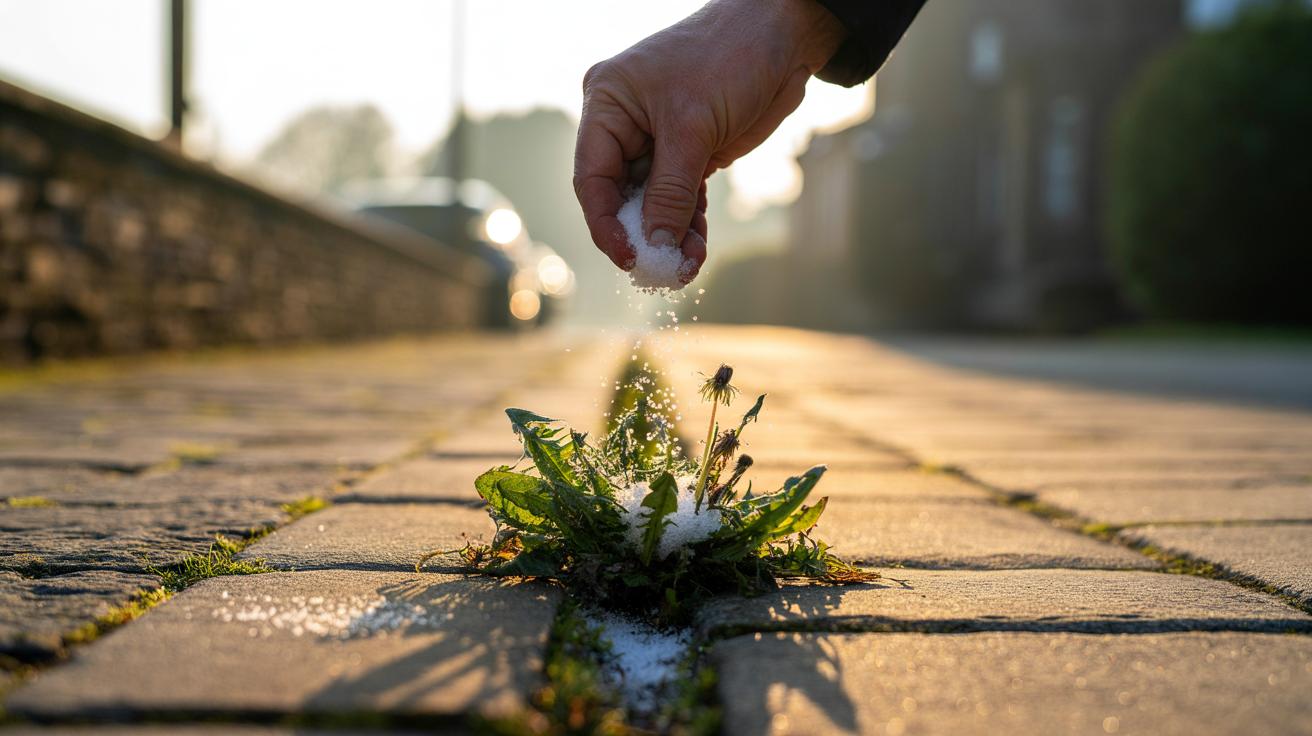
For generations, household salt has been a no-nonsense answer to stubborn paving‑slab invaders and gravel drive weeds. It’s cheap, accessible, and—if you know its limits—remarkably effective. The trick isn’t magic; it’s biology. Salt draws water out of plant tissues, a brutal but natural form of desiccation that halts growth fast. Yet this same power can damage nearby soil and ornamentals if used carelessly. Salt is a non‑selective weedkiller; what it touches, it harms. In driveways, paths, and hard standings, it can be a pragmatic tool. In lawns or beds, it’s often the wrong choice. Here’s how to use it wisely, and when to leave the shaker on the shelf.
Why Salt Kills Weeds on Contact
Salt—most commonly sodium chloride—works through osmotic pressure. When you apply it to weed leaves or the surrounding soil, it creates a highly concentrated solution outside plant cells. Water moves out across cell membranes to balance this gradient, and the cells collapse. The result is rapid dehydration, browning, and death of soft tissues. Young, succulent weeds go first. Older perennials may wilt above ground, yet resprout if their roots escape the worst. That duality explains why salt can look like a miracle one week and a disappointment the next.
There’s a second punch. Salt interferes with nutrient uptake by skewing the balance of essential ions in the rhizosphere, notably potassium and calcium. Stressed plants struggle to photosynthesise, and even light watering can’t undo the ionic imbalance. On hard surfaces, this is precisely the point—kill quickly and prevent re‑establishment. In open soil, though, lingering salinity suppresses not just weeds but the beneficial microbes and future plantings you actually want. Understanding that ecology helps you choose targets wisely and avoid collateral damage.
How to Apply Salt Safely and Effectively
Target location first. Salt is best reserved for impermeable areas—driveways, patio joints, gravel paths where runoff won’t reach beds or drains. Choose dry, still weather. No rain for 24–48 hours is ideal. Spot treat, don’t blanket. A coarse-grain sprinkle onto foliage and into cracks dehydrates quickly; a brine allows precision via a trigger sprayer. Add a drop of washing‑up liquid as a surfactant to help wet waxy leaves. Work early in the season on seedlings, then follow up lightly rather than dosing heavily once. Less is safer, and often more effective.
| Concentration | Mix (by volume) | Best Use | Notes |
|---|---|---|---|
| 3–5% brine | 30–50 g salt per litre water | Annual seedlings on hard edges | Gentle; repeat in 7–10 days if needed |
| 8–10% brine | 80–100 g per litre | Cracks in paving, gravel paths | Good for mixed weeds; avoid overspray |
| Dry application | Pinch per crack | Thick rosettes, moss in joints | Water lightly after for activation |
Hold the nozzle close to the target. Shield prized plants with cardboard. Never pour leftover brine into surface drains or onto lawns. Rinse sprayers afterwards to prevent corrosion. If control lapses, combine salt with hand weeding: loosen the crown with a weeder, remove most of the root, then spot salt the remnant to exhaust regrowth. You’ll use less material and get a cleaner finish.
Risks, Side Effects, and Legal Considerations
Soil salinity is the headline risk. Salt lingers. In compacted sub‑bases under patios it causes few future problems, but in beds and borders it can persist and block future planting for months. Runoff can stress trees whose roots extend under driveways. Pets may lick salty residues; rinse treated areas before allowing them back if you’ve applied heavily. Metal edging and some natural stones can suffer corrosion or efflorescence, so test on a discreet patch first.
There’s also the matter of water. In the UK, it’s an offence to knowingly pollute watercourses; avoid any application that could wash into road gullies, streams, or ponds. Salt is not an approved pesticide for professional amenity use, so it shouldn’t be applied on public land or for hire. On your own property, minimal, targeted use on hard surfaces is generally acceptable, but it remains your responsibility to prevent environmental harm. If in doubt, treat smaller patches and observe the drainage behaviour before scaling up. Finally, remember that salt is non‑selective. Keep it away from soil you plan to cultivate, and never use it as a long‑term barrier in beds—it’s a false economy.
Used precisely, salt can knock back path weeds fast, shrinking your reliance on synthetic herbicides. The science is simple: create an osmotic shock, dehydrate tissues, deny regrowth. The judgement lies in where and how you apply it, and how you mitigate runoff and residue. On paving and gravel, it earns its keep. In the veg patch, it’s a liability. Think like a steward, not a scorched‑earth general. Pair salt with hand weeding and mulch, and you’ll maintain tidy hardscapes without sabotaging the soil nearby. Where will you target your first careful trial, and what safeguards will you put in place to protect the rest of your garden?
Did you like it?4.6/5 (26)