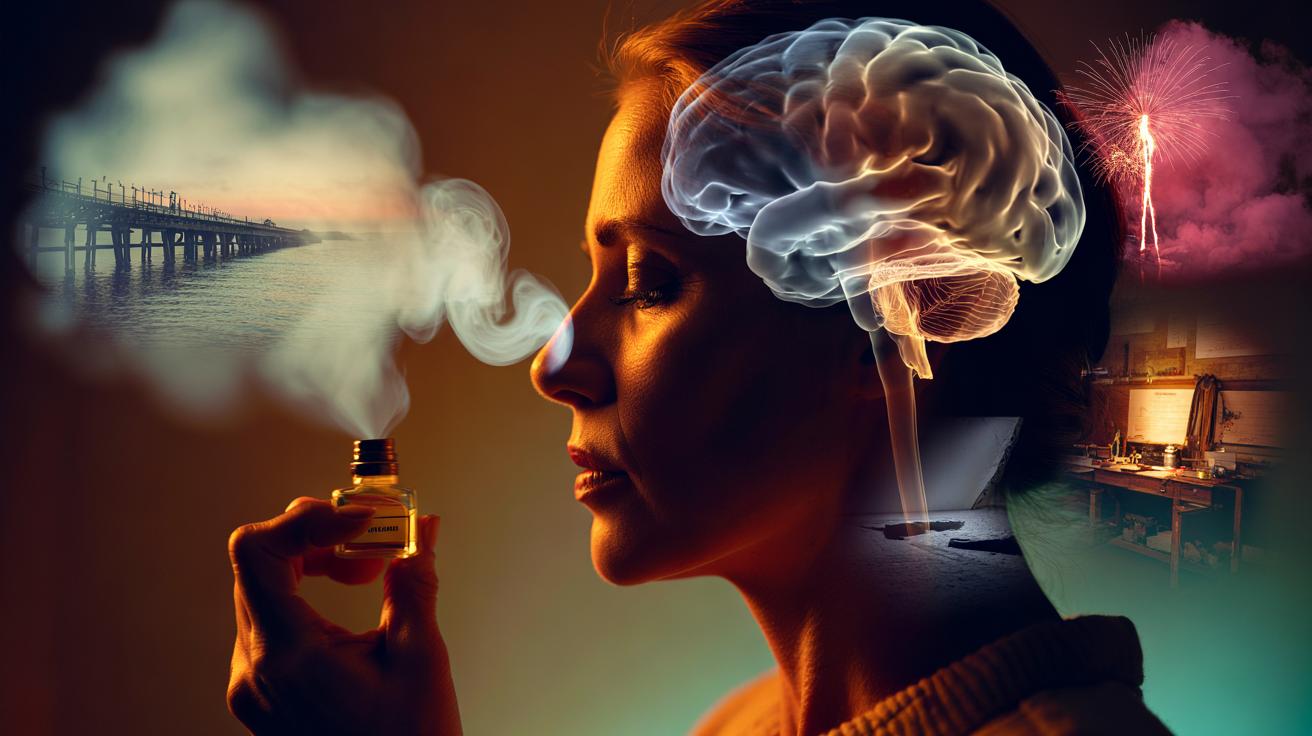
In a nutshell
- 🧠 Smell has a direct neural pathway from the olfactory bulb to the amygdala and hippocampus, giving it privileged access to emotion and autobiographical memory, underpinning the vivid “Proust phenomenon.”
- 👃 Odours act as compact cues through encoding specificity, boosting context- and state-dependent recall; this explains why a whiff can feel like re-entering a past scene rather than merely remembering it.
- 📚 Use scent as a practical anchor: pair a distinctive, pleasant aroma with study or rehearsal to leverage context reinstatement; keep exposure brief to avoid olfactory adaptation and be mindful of sensitivities.
- 🏬 Marketers and designers deploy scent branding to shape mood and identity in retail, hospitality, and exhibitions, but ethical practice demands transparency, subtlety, and fragrance-free options.
- 🔑 Olfactory recall is culturally and personally shaped: the same scent can comfort one person and repel another as expectations, mood, and life experience write unique associations onto the nose.
The faint spice of mulled wine at a winter market, the diesel-tinged air of a dawn commute, the clean sting of antiseptic in a hospital corridor: scents summon scenes with startling sharpness. This is no parlour trick. It is a neurobiological shortcut that binds smell to autobiographical detail, mood, and place. Many of us know the “Proust phenomenon”, when a whiff unspools a hidden reel of memory with cinematic clarity. Scent does not merely remind; it reinstates the emotional climate of a past moment, explaining why recollections attached to odour often feel richer, more embodied, and curiously immediate.
The Neuroscience Behind Scent and Memory
Unlike sights and sounds, which typically detour through the thalamus for extensive processing, olfactory signals travel rapidly from the nose to the olfactory bulb, then into the piriform cortex, amygdala, and hippocampus. These are the brain’s emotional and memory engines. That directness is decisive. Scent enjoys privileged, emotionally loaded access to autobiographical memory, so a single inhalation can ignite networks encoding context, people, and place. In lab terms, smell is a potent cue for context-dependent and state-dependent recall, which is why aromas can unlock data that stubbornly resists visual or verbal prompts.
The smell–memory bond is reinforced by learning. Encoding specificity means details are stored alongside the conditions present at the time—lighting, mood, and, crucially, odour. Volatile compounds lodge in recollection as “labels” that make later retrieval more efficient. That’s why “petrichor” after summer rain revives a childhood campsite as faithfully as a photograph. Odour cues are compact, distinctive, and neurologically sticky, enabling fast, high-fidelity recall that feels less like reconstruction and more like re-entry.
| Sense | First Cortical Stop | Limbic Access | Typical Trigger Strength |
|---|---|---|---|
| Smell | Piriform Cortex | Direct to Amygdala/Hippocampus | High, vivid, emotional |
| Hearing | Auditory Cortex | Indirect via Thalamus | Moderate, narrative |
| Vision | Visual Cortex | Indirect via Thalamus | Moderate, detailed |
| Taste | Gustatory Cortex | Linked to Limbic via Insula | High, but less specific |
Cultural and Personal Layers of Olfactory Recall
Biology provides the wiring; life supplies the content. Odours carry learned associations that differ by household, region, and era. In the UK, the briny lift of sea air may pull you to windswept piers and vinegar-drenched chips, while the sulphuric ghost of spent fireworks recalls Bonfire Night. Smell is a social record as much as a sensory one, picking up cues from family routines, cleaning products, school halls, and workplaces that accumulate into a private olfactory lexicon.
These layers explain why one person’s cosy nostalgia is another’s aversion. Hospital disinfectant can signal safety to a nurse and dread to a patient. The same perfume can feel romantic or claustrophobic depending on the story stitched to it. Expectations and mood also filter perception; an aroma encountered during stress may tag future whiffs with tension. Olfactory memory is personal, plastic, and deeply contextual, fusing cultural scripts with the brain’s proclivity to bind smell and feeling.
Using Scent as a Practical Memory Anchor
You can harness this circuitry with intention. Choose a distinctive, pleasant odour—a particular tea, essential oil, or hand cream—and pair it consistently with a task or topic. Study a subject while diffusing the same aroma, then reintroduce it when revising or sitting a mock exam. This leverages context reinstatement, helping the brain reassemble the original network. Keep exposure brief and consistent; over-saturating a room causes olfactory adaptation, dulling the cue. The goal is a crisp, reliable signal, not a fog of fragrance.
Timing matters. Attach the scent to a specific phase of work, such as first-pass reading or recall drills, so the cue predicts a behaviour. Combine with spaced repetition and apply the anchor across varied settings to prevent over-contextualisation. For public speaking or performance, a discreet scent on a wrist can prompt calm by reviving a rehearsed state. Do note sensitivities—avoid triggers for asthma or migraine. A well-chosen aroma can become a portable doorway into focus, fluency, and confidence.
What Marketers and Designers Already Know
Retailers and hospitality operators deploy scent branding to make spaces feel coherent and memorable. A warm vanilla-citrus blend hints at comfort and cleanliness; a green, ozonic accord signals freshness in gyms or transport hubs. Scent sketches identity in air, encouraging dwell time and nudging mood without a word. Museums and immersive exhibits now experiment with controlled odours to conjure historical scenes, proving how smell can deepen understanding as much as it drives sales.
Yet the ethics matter. Olfactory cues can be manipulative if used to mask flaws or stimulate spending beyond intention. Designers should publish scent policies, offer fragrance-free zones, and adopt low-intensity, hypoallergenic formulas. The same principles guide workplaces: a subtle, consistent background note can aid wayfinding and reduce stress, but heavy-handed diffusion backfires. The best applications respect autonomy, deliver clarity of place, and acknowledge that memory—like smell—is intensely individual, not a blunt instrument for steering crowds.
Smell is not a magic wand, but a reliable ally that turns the air itself into a mnemonic device. By pairing distinctive aromas with learning, wellbeing, or design goals, we transform invisible molecules into precision cues that revive context and feeling with unusual fidelity. Used wisely, scent makes recall faster, richer, and kinder to our nerves. What odour would you choose as your anchor—something comforting from childhood, or a novel note with no baggage at all—and how might you test its power in the week ahead?
Did you like it?4.6/5 (30)